

QUIVER
Assistente alla coreografia e consulente creativo Fabrizio Calanna
Elaborazioni sonore e musiche originali Marcello Gori
Progetto luci Marcello Marchi / Alessandro Barbieri
Costumi e scene Maria Barbara De Marco
Assistenti costumi e scene Cecilia Ferrero e Marco De Croix
Produzione SPACCA / Sanpapié
Con il contributo di
Ministero della Cultura (MiC)
Regione Emilia-Romagna – Legge Regionale 13/99
Comune di Milano – Attività di spettacolo a carattere continuativo
Con il supporto di
Improdance Festival
Akbank Sanat
Marche Teatro
Inteatro / Polverigi
Festival Resistere e Creare – Fondazione Luzzati Teatro della Tosse
Parte del progetto
SII ACQUA. La diversità culturale nutre il quartiere, a cura di Magnete Milano, con il contributo di Fondazione Cariplo
Si ringraziano per il contributo creativo al progetto Serhat Kural, Barış Diker, Beste Demir, Şiva Canbazoğlu, Ay Çakır, Fabrizio Calanna, Michele Hu, Giulia Pironi, Gioele Cosentino
“Per coloro che parlano
quando non dovrebbero,
che ricordano che siamo
stati sopravvissuti,
nonostante tutto,
perché parlare, anche da soli,
è già sopravvivere.”
— Audre Lorde
QUIVER nasce da una collaborazione internazionale con Improdance Festival di Istanbul. Una prima residenza in Turchia e un processo di selezione avrebbero dovuto portare alcuni danzatori turchi a lavorare in Italia. Le difficoltà burocratiche e l’impossibilità per i performer selezionati di raggiungere il Paese interrompono il percorso previsto. Questa frattura non viene rimossa né risolta, ma assorbita nella creazione, che prosegue con un nucleo interculturale di giovani artisti.
QUIVER si sviluppa così come un campo di tensione tra impulso vitale e opposizione, tra dimensione festiva e gesto di protesta. Il lavoro interroga il corpo come spazio esposto, vulnerabile e resistente, attraversato da forze contrastanti e da sistemi visibili e invisibili che ne condizionano la presenza.
Il movimento non cerca una forma definitiva, ma una condizione. I corpi diventano manifesti incarnati e la danza uno strumento per interrogare il rapporto tra individuo e sistema, tra desiderio di libertà e meccanismi di controllo, tra partecipazione e sottrazione.
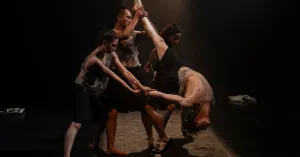
Tra danza, parola e azione, quattro interpreti attraversano il confine tra inerzia e desiderio, torpore e rivolta, festa e protesta. Il corpo trema, si accende, rifiuta la stasi e genera la propria combustione. QUIVER è un atto di insubordinazione sensibile: un linguaggio che disobbedisce alla forma, un movimento che accende la coscienza, una vibrazione che rompe l’equilibrio e ne rivela la fragilità.
La scena è uno spazio essenziale abitato da corpi di gabbiani senza vita. Lo spazio, invisibile ma vivo come un quinto danzatore, determina la condizione dei corpi; sonorità, frammenti di testo e luce interagiscono con la danza in partiture autonome. In un gioco a tratti metateatrale, la concretezza dei corpi si confronta e si scontra con un sistema invisibile capace di rovesciare la scena, manipolarla, dirottarla.
Non c’è narrazione: solo condizione.
***
Quiver means movement that trembles, vibrates, presses, pulsates and stirs under the skin without explanations or objectives, a movement that neither feels nor seeks reasons for its vital restlessness and slips between the lines of imaginary borders devouring their dictates. Quiver is precisely the snakes and fire that question form and matter, denouncing their limits and precariousness, that overstep skeletal and architectural structures to expose the incomprehensible fragility of change and impermanence, declaring war on definitions, style and obedience. Quiver is an agitation that passes from body to body, a whisper that becomes song, a spark that enters the joints and mixes the bones in a ritual dance that celebrates only its own presence. No narration but the igniting of fires in space, between dancers, spectators and environment in the simultaneous presence of nearby bodies, of perceptions that do not have time to name themselves, in the round dance that makes us move so fast that they seem like the same face.
It is no longer important to know why we are in a place or what we have come to do: Quiver is the thrill that underlies the push, the action, the saying, the embrace between bodies, the impact, the comparison, the affront and the revolt. It trascend the boundary between Party and Protest in a score that makes them synonymous in the time of the performance. Quiver bursts in like a primitive carnival, a surreal manifestation travelling aimlessly across the Mediterranean, between Turkey and Italy, gathering diversity and assonances in the path traced by the thousand-year-old philosophical, literary and artistic tradition that binds us.
Dance condenses, in the present of action, the encounter between different times and ways in search of the fusion point capable of connecting and integrating them in a constant flow of movement that includes the audience as a scenic element and active interlocutor. The principles of contemporary dance merge with those of traditional Mediterranean dances in a careful study of similarities, fusion points, revisitations and comparisons to provoke the body to be a living manifesto of encounter and exchange capable of combining the “bottom-up” and the ”top-down” culture by blurring the imaginary border that surrounds them.
The project aims to challenge itself not only in its content and choreographic research but also in the form it can take, seeking a principle of permeability, listening, and real integration with different contexts and environments. The creative process will develop along a dual track, organizing dramaturgy for both conventional theater spaces and site-specific performances, constructing pathways and interactions with various urban spaces and landscapes. The challenge we set for ourselves is to truly be "ecological," to be able to apply principles of adaptability, sustainability, and interaction with the places, structures, projects, and communities we will encounter, building a clear and defined structure while remaining open to co-design and the artistic provocations it offers.
Fonte Traduzione: Liv. In. G.